CloudFormation for Beginners: The Fastest Way to Learn AWS Infrastructure as Code
A beginner CloudFormation guide covering templates, stacks, change sets, drift, rollback, and how infrastructure as code helps AWS certification learners.
Cloud Conquer Team
AWS Learning Coach
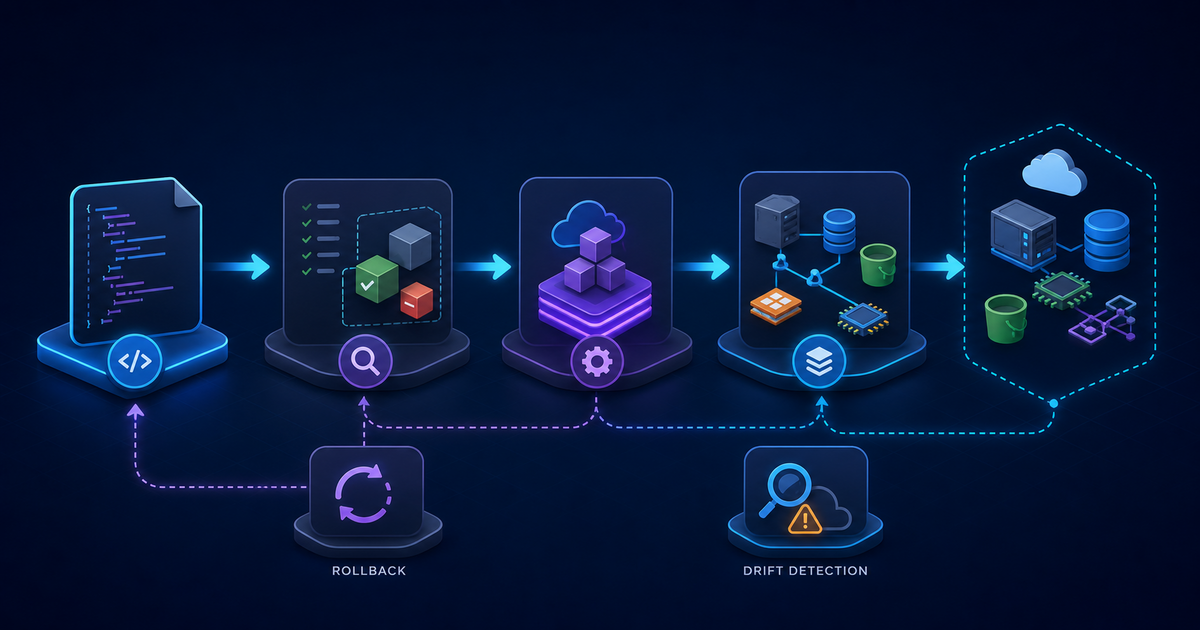
CloudFormation for Beginners is worth learning because it gives you a reusable decision rule, not just another AWS service name to memorize. This guide is for AWS learners who have clicked through the console and want repeatable infrastructure without jumping straight into every IaC tool at once. By the end, you should be able to understand the CloudFormation workflow before memorizing template syntax.
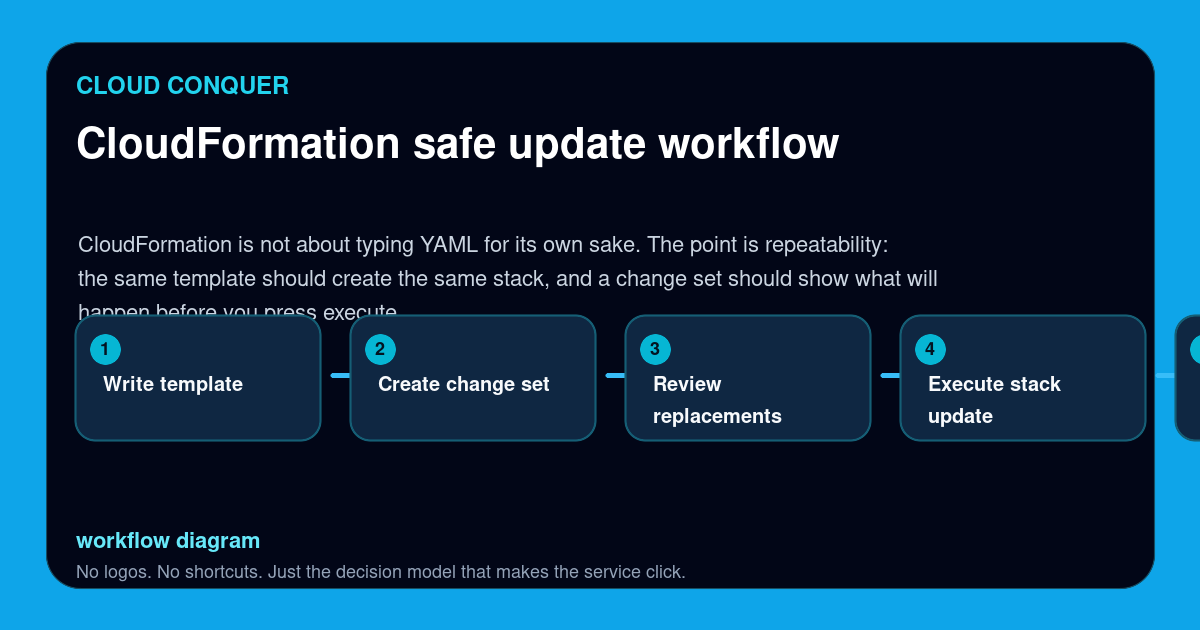
Here is the short version worth saving: CloudFormation is not about typing YAML for its own sake. The point is repeatability: the same template should create the same stack, and a change set should show what will happen before you press execute.
If you are building your AWS study path, connect this article with Amazon EC2 for beginners, AWS Lambda for beginners, Amazon RDS for beginners, Developer Associate guide so the concept becomes part of a system instead of a one-off note.
The Mental Model
A CloudFormation template describes desired AWS resources. A stack is the live collection of resources created from that template. A change set previews the impact of an update. Rollback protects you when a stack operation fails.
A good learner can explain the service in plain English before naming every feature. A good certification answer does the same thing under pressure: identify the workload, remove the distractors, then choose the AWS feature that matches the requirement.
Save This Decision Table
| Concept | Simple meaning | Why it matters |
|---|---|---|
| Template | The infrastructure definition | Usually YAML or JSON |
| Stack | The managed collection of resources | Create, update, and delete as one unit |
| Change set | Preview of proposed changes | Use it before risky updates |
| Drift | Difference between template and real resources | Important when console edits sneak in |
| Rollback | Failure recovery behavior | Know what happens when creation or update fails |
This table is the part to share with another learner. It compresses the topic into the decisions that show up in labs, architecture reviews, and exam questions.
The Workflow To Remember
CloudFormation safe update workflow:
- Write template
- Create change set
- Review replacements
- Execute stack update
- Monitor rollback or success
Do not skip the order. AWS questions often become difficult because they mix several concepts in one paragraph. When you slow the scenario down into a workflow, the answer usually becomes less mysterious.
A Safe Beginner Lab
- Start with a template that creates one simple S3 bucket or security group.
- Create the stack and inspect the Events tab.
- Change a harmless tag and create a change set.
- Review the proposed update before execution.
- Delete the stack when done.
The point of the lab is not to create a production-grade environment. The point is to build enough muscle memory that the words in the documentation and the words in practice exams map to something you have actually seen.
Common Mistakes
- Editing resources manually and forgetting the template no longer matches reality.
- Skipping change sets for resources that might be replaced.
- Treating a stack delete as harmless when stateful resources are inside it.
- Learning syntax before learning the lifecycle.
These mistakes are common because AWS makes it easy to create resources before you fully understand the boundary between configuration, security, cost, and operations. Slow down at those boundaries. That is where the learning happens.
How This Shows Up In AWS Certifications
Developer Associate includes deployment and CI/CD workflows, while CloudOps and Solutions Architect both expect IaC awareness. You do not need to become a template wizard first. You do need to understand stacks, updates, change sets, and rollback behavior.
For practice, take any question you miss and rewrite it as a decision sentence. Example: "The workload needs outbound internet access from a private subnet, so I need a NAT path." That habit turns wrong answers into reusable judgment instead of trivia.
Shareable Study Prompt
Use this prompt after reading:
In one paragraph, explain when I would use this AWS concept, what mistake I should avoid, and which certification scenario would test it.
If you cannot answer that cleanly, reread the decision table and redraw the workflow from memory. If you can answer it, move to the next article in the cluster and connect the concept to a real scenario.
Official AWS Sources Used
Next Step
Open Amazon EC2 for beginners, AWS Lambda for beginners next. Then answer five practice questions and write down the exact phrase that made each correct answer correct. That small review loop is what turns reading into exam readiness.
Read Next
Continue this AWS learning path
These links are intentionally sequenced to move readers from fundamentals to certification-ready topics.
Amazon EC2 for Beginners: Instances, AMIs, Security Groups, and When to Use It
A practical beginner guide to EC2 instance basics, AMIs, security groups, pricing models, and when EC2 is a better fit than serverless.
AWS Lambda for Beginners: How Serverless Works and When to Use It
A beginner-friendly Lambda guide that explains the serverless mental model, EC2 trade-offs, the first safe lab, and the exam cues to watch for.
Amazon RDS for Beginners: Engines, Multi-AZ, Backups, and Read Replicas
A practical Amazon RDS guide that explains managed relational databases, engine choice, Multi-AZ, backups, read replicas, and certification decision cues.
Build Your First Serverless AWS App: Lambda, API Gateway, and DynamoDB
A beginner serverless project walkthrough that explains the request flow, service responsibilities, IAM permissions, testing path, and cleanup plan.