AWS Lambda for Beginners: How Serverless Works and When to Use It
A beginner-friendly Lambda guide that explains the serverless mental model, EC2 trade-offs, the first safe lab, and the exam cues to watch for.
Cloud Conquer Team
AWS Learning Coach
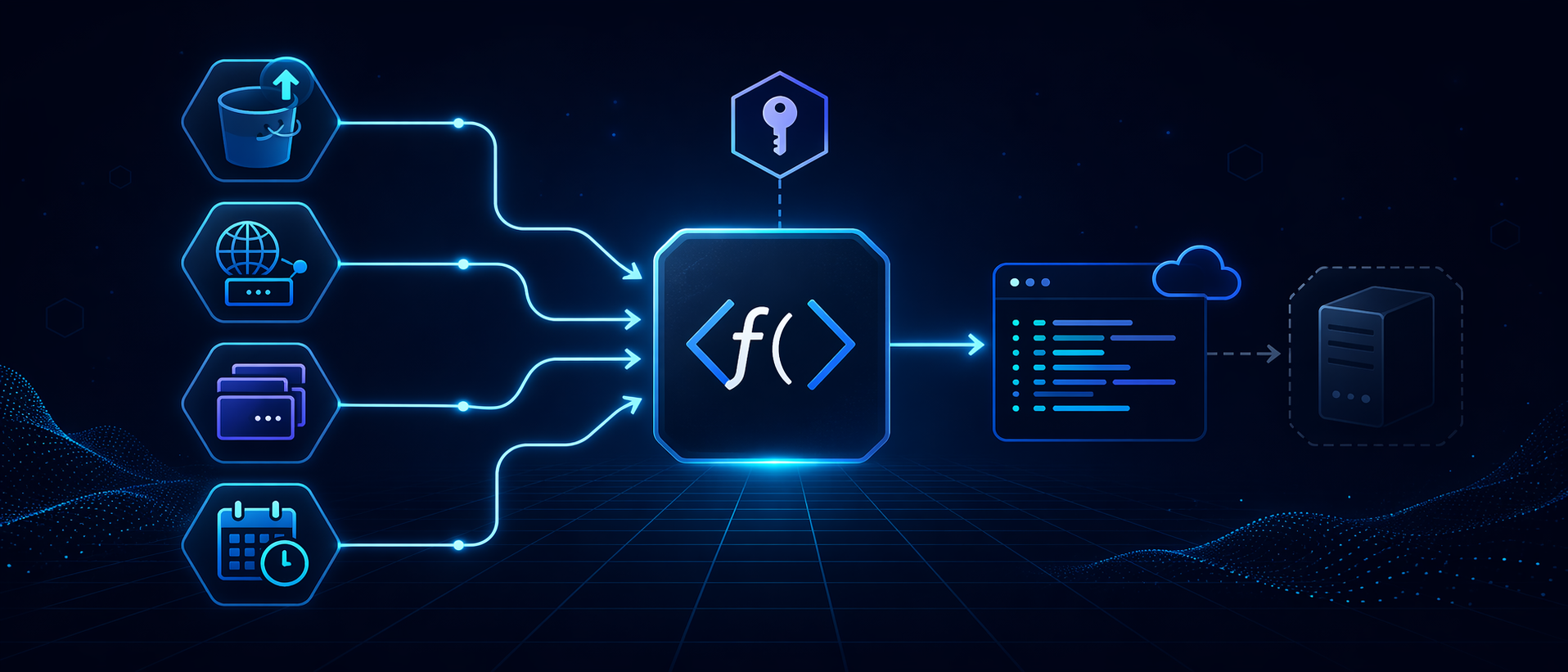
AWS Lambda is AWS's serverless compute service. You write a function, attach an event source, and AWS runs the code only when something happens. That makes Lambda a strong fit for short, event-driven work that does not need an always-on server. If you need operating-system control, long-running processes, or custom agents, EC2 is the better fit. If you are learning AWS from zero, Lambda clicks best after IAM and cost safety; if you are studying for Developer Associate, it is one of the highest-yield services you can learn.
This guide is for two groups: beginners who want the serverless mental model and Developer Associate candidates who need to stop guessing on Lambda questions.
The Mental Model
| Part of the flow | What happens | Why it matters |
|---|---|---|
| Trigger | An event starts the function | S3 uploads, API calls, queue messages, or timers can all trigger Lambda |
| Function | Your code runs for the event | You think in small units of work, not servers |
| Execution role | Lambda assumes permissions to do work | IAM still matters because the function needs access to logs and downstream services |
| Logs and retries | AWS handles the plumbing around the invocation | You spend less time managing infrastructure and more time on the code path |
If that mental model feels natural, the rest of Lambda gets easier quickly.
When Lambda Fits Best
Lambda is a strong choice when the work is:
- event-driven
- bursty or intermittent
- short-lived
- okay with paying only for usage
- easier to express as a function than as a long-running service
Common beginner examples:
- resize an image when it lands in S3
- process a queue message
- respond to an API request
- run a scheduled cleanup job
- glue two AWS services together
That is why Lambda belongs in the same beginner path as AWS IAM explained for beginners, AWS Free Tier guide, and Learn AWS From Scratch.
Lambda vs EC2
| Question | Choose Lambda when | Choose EC2 when |
|---|---|---|
| Do you need server control? | No | Yes |
| Is the workload event-driven? | Yes | Not usually |
| Is the work short-lived? | Yes | No, or not mainly |
| Do you want the lowest ops overhead? | Yes | No |
| Is the service a better fit for code that reacts to events? | Yes | Sometimes, but EC2 is broader |
A good exam answer usually comes from the shape of the workload, not from a preference for "modern" tooling.
A Safe First Lab
A first Lambda lab should be tiny:
- create a hello-world function
- use a test event from the console
- give the function the minimum execution role it needs
- open the logs and verify the output
- delete the function when you are done
If you want to keep the lab cost-safe, pair it with the AWS Free Tier guide and keep the scope narrow.
Common Mistakes
Treating Lambda like a mini server
Lambda is not a place to manage a machine. You are writing code for a runtime that AWS runs for you.
Forgetting permissions
If the function cannot write logs or access downstream services, the problem is often IAM, not the code itself. That is why the IAM guide matters so much.
Choosing Lambda for long-running jobs
Lambda is a bad fit for tasks that need a long-lived process or more control over the runtime environment. That is EC2 territory.
Ignoring the timeout and execution model
If the function is doing work that does not fit the invocation model, the architecture is wrong. Do not force it.
Why It Matters for Certifications
For Cloud Practitioner, Lambda is part of the basic AWS service vocabulary.
For Developer Associate, you need to understand invocation patterns, execution roles, retries, event sources, and how Lambda fits into serverless application design.
For Solutions Architect Associate, Lambda matters because the exam often asks you to choose between Lambda and EC2 based on cost, latency, and operational fit. The right answer is usually the one that matches the constraint, not the one that sounds more impressive.
If you want the broader study path, keep the Developer Associate guide and the Solutions Architect Associate guide open while you study. If your next weak spot is service selection, the practice exam strategy guide helps turn misses into a review loop.
Recommendation
Learn Lambda after IAM and cost safety, not before them. Once you understand triggers, execution roles, and the EC2 trade-off, serverless stops feeling mysterious. It becomes one more clean tool in the AWS toolbox, which is exactly what you need for both real work and exam questions.
Read Next
Continue this AWS learning path
These links are intentionally sequenced to move readers from fundamentals to certification-ready topics.
AWS IAM Explained for Beginners: Users, Roles, Policies, and Real Examples
A practical IAM guide for AWS beginners. Learn users, roles, policies, permission boundaries, and the mental model that makes IAM click.
AWS Free Tier Guide 2026: How to Learn AWS Without Surprise Bills
A practical guide to using the AWS Free Tier safely while learning core services, building labs, and preparing for beginner AWS certifications.
Learn AWS From Scratch in 2026: A Beginner Roadmap That Actually Works
A practical beginner roadmap for learning AWS from zero without wasting months on random services, videos, and certifications.
How to Pass AWS Developer Associate in 30 Days: 2026 Update
A practical 30-day DVA-C02 plan for developers who need to prioritize Lambda, DynamoDB, IAM, API Gateway, and real exam trade-offs.