RDS vs DynamoDB: How to Choose the Right AWS Database
A practical AWS database comparison that explains when to choose RDS, when to choose DynamoDB, and the exam clues that separate them.
Cloud Conquer Team
AWS Architecture Coach
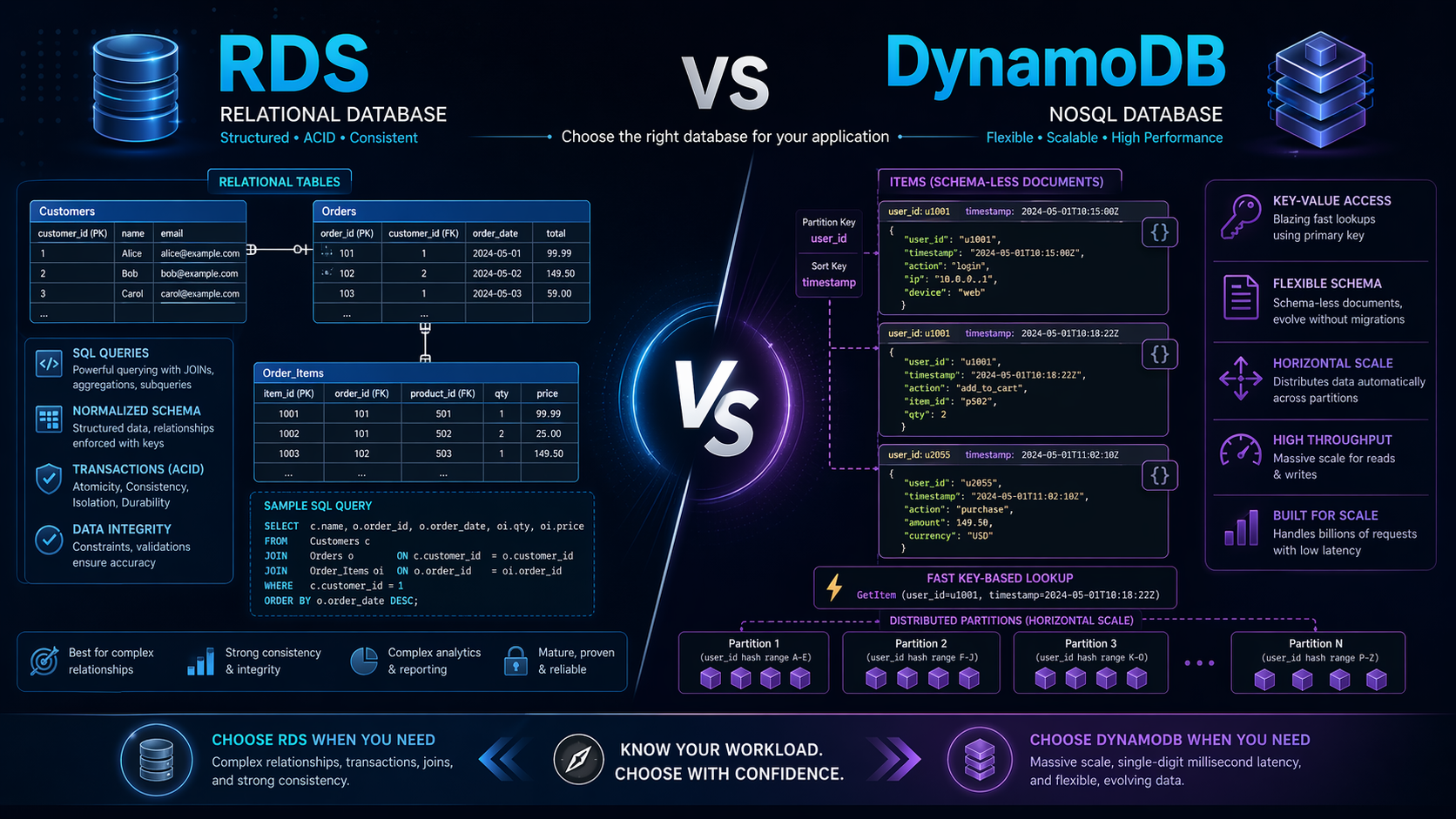
RDS vs DynamoDB is not a popularity contest. It is a decision about data model, query shape, and operational fit. Use RDS when you need SQL, joins, transactions, or a traditional relational schema. Use DynamoDB when you want access-pattern-first design, high scale, and low-latency key-value or document access without managing a relational system. If you are studying for Solutions Architect Associate or Developer Associate, this comparison shows the exact decision rule AWS exam writers expect you to know.
The Decision Table
| Need | RDS | DynamoDB |
|---|---|---|
| SQL and joins | Best fit | Poor fit |
| Flexible ad hoc queries | Better fit | Not the point |
| Access pattern known upfront | Can work | Best fit |
| High-scale low-latency lookups | Possible, but not the core model | Best fit |
| Traditional relational schema | Yes | No |
| Operational simplicity at extreme scale | More work | Strong fit |
If the table already points to one answer, stop overthinking it. The best database is the one that matches the workload.
The RDS Mental Model
RDS is AWS's managed relational database service. You still think in terms of tables, relationships, SQL, and engine choice, but AWS handles the routine infrastructure tasks that would normally eat your time.
Use RDS when you want:
- a relational schema
- SQL queries and joins
- transactions and familiar database behavior
- a database that maps well to existing application design
RDS is why the Solutions Architect Associate guide keeps database trade-offs near the center of the study plan.
The DynamoDB Mental Model
DynamoDB is not a smaller relational database. It is a NoSQL database built around primary keys, partition design, and known access patterns. You model the table around the questions the application will ask, not around a normalized relational schema.
Use DynamoDB when you want:
- low-latency key-value or document access
- access patterns that are known ahead of time
- throughput that can scale without a lot of operational effort
- a database that pairs naturally with serverless and event-driven apps
That is why DynamoDB shows up so often in the Developer Associate guide and in AWS Lambda for beginners.
When To Choose RDS
Choose RDS when:
- the workload depends on SQL
- joins are part of the normal query path
- you need a familiar relational schema
- the application is easier to reason about with normalized data
- the exam wording points to a traditional database
RDS is the right answer when the data model is relational and the query shape stays relational.
When To Choose DynamoDB
Choose DynamoDB when:
- you know the access patterns before you build
- you need very low-latency reads and writes at scale
- the application is event-driven or serverless
- you want to avoid relational database management overhead
- the question is really about primary-key lookups or indexed access
If your app already leans toward Lambda, DynamoDB is often the natural companion.
The Trade-Offs AWS Exams Care About
| Trade-off | RDS | DynamoDB |
|---|---|---|
| Data model | Relational | NoSQL |
| Query flexibility | High | Lower, because you design around access patterns |
| Scaling style | More traditional database scaling choices | Throughput modes and partition-aware design |
| Ops overhead | Higher than DynamoDB | Lower for many serverless workloads |
| Typical exam cue | SQL, joins, transactions | Access patterns, keys, high scale, serverless |
The trick is not memorizing product marketing. The trick is matching the question wording to the database shape.
Common Mistakes
Assuming DynamoDB is "just faster"
DynamoDB is not a universal upgrade from RDS. It solves a different problem.
Choosing RDS before defining the query
If you do not know the query shape, you do not really know whether RDS is the right fit.
Using DynamoDB for ad hoc reporting
If the workload needs flexible queries or joins, DynamoDB is usually the wrong answer.
Ignoring the access pattern
When AWS exam questions give you the access pattern, that clue matters more than the service name you prefer.
Why It Matters for Certifications
For Solutions Architect Associate, the main task is to choose the database that best matches the workload and its constraints. The exam often hides that choice behind words like cost optimization, scalability, or resilience.
For Developer Associate, the common pattern is Lambda plus DynamoDB, where you need to understand both the function and the table design. That is why the Lambda guide and the Developer Associate guide work well together.
If you want to keep the study path connected, use the AWS certification roadmap to choose the next milestone and the practice exam strategy guide to turn wrong answers into a better decision rule.
Recommendation
Use RDS when the world is relational. Use DynamoDB when the workload is access-pattern driven and scale matters more than SQL flexibility. If you can say that clearly, you are already ahead of most exam distractors.
Read Next
Continue this AWS learning path
These links are intentionally sequenced to move readers from fundamentals to certification-ready topics.
AWS Solutions Architect Associate Study Guide 2026
A focused 2026 SAA-C03 study guide covering the services, trade-offs, and study order that matter most for a first-pass result.
How to Pass AWS Developer Associate in 30 Days: 2026 Update
A practical 30-day DVA-C02 plan for developers who need to prioritize Lambda, DynamoDB, IAM, API Gateway, and real exam trade-offs.
AWS Certification Roadmap 2026: Which AWS Cert Should You Get First?
A practical 2026 roadmap for choosing your first AWS certification based on your background, time budget, and career goal.
Practice Exam Strategies That Actually Work for AWS Certifications in 2026
How to use AWS practice exams correctly in 2026 so your mocks reveal gaps, improve retention, and translate into a real pass.