DynamoDB for Beginners: Partition Keys, Capacity Modes, and Common Pitfalls
A beginner-friendly DynamoDB guide for understanding partition keys, sort keys, capacity modes, access patterns, and the mistakes that show up in AWS exams.
Cloud Conquer Team
AWS Developer Coach
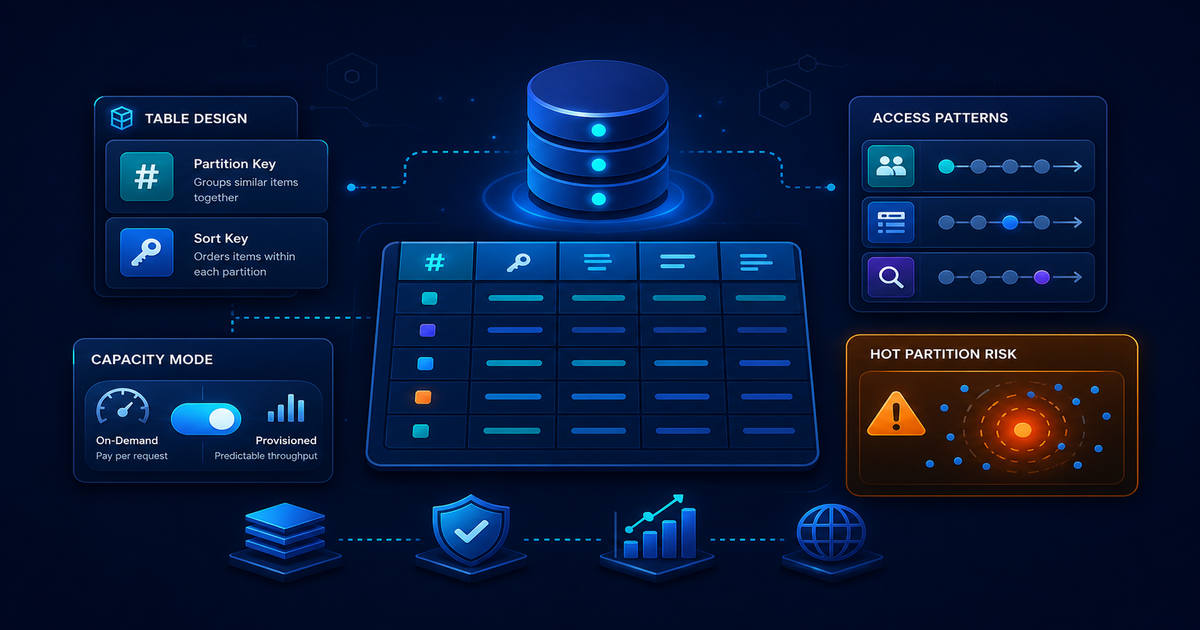
DynamoDB for Beginners is worth learning because it gives you a reusable decision rule, not just another AWS service name to memorize. This guide is for developers and certification learners who hear DynamoDB is serverless but do not yet know how to model data for it. By the end, you should be able to learn the DynamoDB decision rules that matter before writing a table schema.
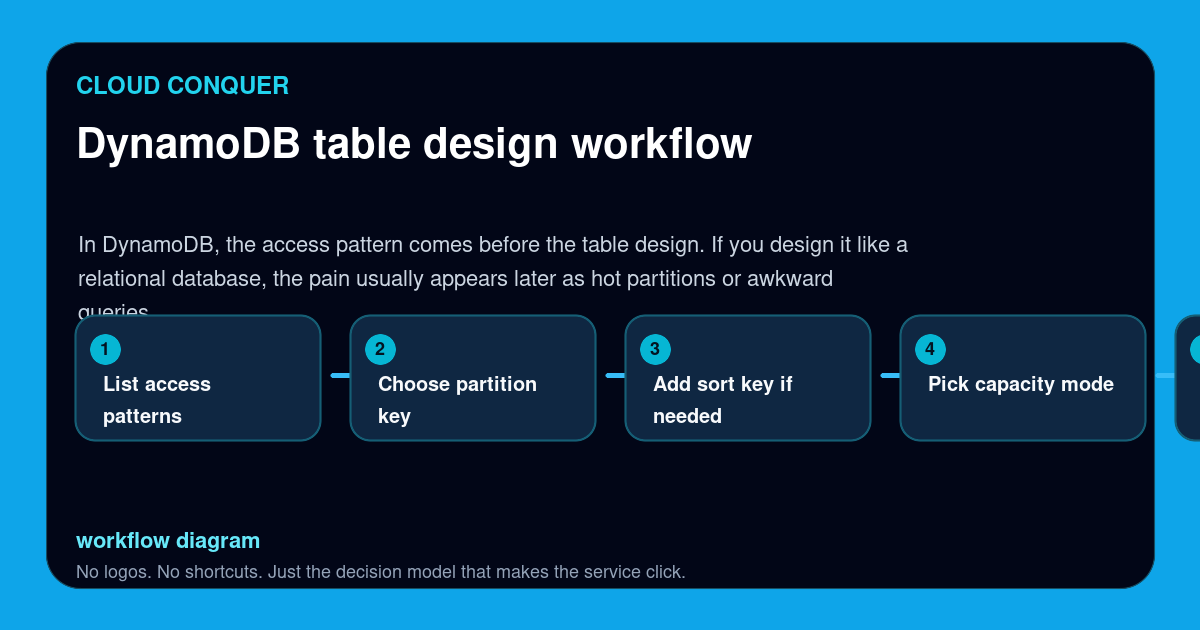
Here is the short version worth saving: In DynamoDB, the access pattern comes before the table design. If you design it like a relational database, the pain usually appears later as hot partitions or awkward queries.
If you are building your AWS study path, connect this article with RDS vs DynamoDB, AWS Lambda for beginners, Developer Associate guide, practice exam strategy guide so the concept becomes part of a system instead of a one-off note.
The Mental Model
DynamoDB is a managed NoSQL database built for key-based access at scale. You do not start with normalized tables and then ask any query you want. You start with the questions the application must answer, then choose keys and indexes that make those answers efficient.
A good learner can explain the service in plain English before naming every feature. A good certification answer does the same thing under pressure: identify the workload, remove the distractors, then choose the AWS feature that matches the requirement.
Save This Decision Table
| Concept | Simple meaning | Why it matters |
|---|---|---|
| Partition key | Distributes items across partitions | A bad key can create hot partitions |
| Sort key | Orders related items under the same partition key | Useful for time ranges and grouped records |
| On-demand mode | Pay per request with automatic scaling | Good default for unpredictable workloads |
| Provisioned mode | Pre-set read and write capacity | Useful when traffic is predictable |
| Global secondary index | Another query path | Helpful, but every index has cost and design impact |
This table is the part to share with another learner. It compresses the topic into the decisions that show up in labs, architecture reviews, and exam questions.
The Workflow To Remember
DynamoDB table design workflow:
- List access patterns
- Choose partition key
- Add sort key if needed
- Pick capacity mode
- Review hot key risk
Do not skip the order. AWS questions often become difficult because they mix several concepts in one paragraph. When you slow the scenario down into a workflow, the answer usually becomes less mysterious.
A Safe Beginner Lab
- Write three access patterns for a simple study-notes app.
- Create a table with userId as the partition key and noteCreatedAt as the sort key.
- Insert ten sample notes and query by one user.
- Switch mentally between on-demand and provisioned mode and explain the trade-off.
- Delete the table after the lab.
The point of the lab is not to create a production-grade environment. The point is to build enough muscle memory that the words in the documentation and the words in practice exams map to something you have actually seen.
Common Mistakes
- Using a low-cardinality partition key such as status when most items share the same value.
- Expecting joins because the service feels like a database.
- Adding indexes before writing down the actual access patterns.
- Choosing provisioned capacity without enough traffic history to forecast demand.
These mistakes are common because AWS makes it easy to create resources before you fully understand the boundary between configuration, security, cost, and operations. Slow down at those boundaries. That is where the learning happens.
How This Shows Up In AWS Certifications
Developer Associate questions frequently pair Lambda with DynamoDB and ask about permissions, retries, throughput, or key design. Solutions Architect questions often test whether DynamoDB is a better fit than RDS when the workload needs high-scale key-value access instead of SQL joins.
For practice, take any question you miss and rewrite it as a decision sentence. Example: "The workload needs outbound internet access from a private subnet, so I need a NAT path." That habit turns wrong answers into reusable judgment instead of trivia.
Shareable Study Prompt
Use this prompt after reading:
In one paragraph, explain when I would use this AWS concept, what mistake I should avoid, and which certification scenario would test it.
If you cannot answer that cleanly, reread the decision table and redraw the workflow from memory. If you can answer it, move to the next article in the cluster and connect the concept to a real scenario.
Official AWS Sources Used
Next Step
Open RDS vs DynamoDB, AWS Lambda for beginners next. Then answer five practice questions and write down the exact phrase that made each correct answer correct. That small review loop is what turns reading into exam readiness.
Read Next
Continue this AWS learning path
These links are intentionally sequenced to move readers from fundamentals to certification-ready topics.
RDS vs DynamoDB: How to Choose the Right AWS Database
A practical AWS database comparison that explains when to choose RDS, when to choose DynamoDB, and the exam clues that separate them.
AWS Lambda for Beginners: How Serverless Works and When to Use It
A beginner-friendly Lambda guide that explains the serverless mental model, EC2 trade-offs, the first safe lab, and the exam cues to watch for.
How to Pass AWS Developer Associate in 30 Days: 2026 Update
A practical 30-day DVA-C02 plan for developers who need to prioritize Lambda, DynamoDB, IAM, API Gateway, and real exam trade-offs.
Practice Exam Strategies That Actually Work for AWS Certifications in 2026
How to use AWS practice exams correctly in 2026 so your mocks reveal gaps, improve retention, and translate into a real pass.